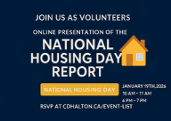
CDH January 19 National Housing Day 2025 Report Executive Summary
National Housing Day 2025 brought together approximately 150 community members in Halton including people with lived experience, housing and social service providers, faith groups, municipal and regional staff and elected officials. Hosted by Community Development Halton, the event focused on moving from understanding the housing crisis to strengthening connection, collaboration and action across the community.
Participants shared a common understanding that Halton is facing a deepening housing crisis, driven by rising homelessness, unaffordable rents and declining access to home ownership. Most attendees felt that not enough is being done to address these challenges. Panel discussion and small-group conversations highlighted the importance of coordinated advocacy, clear public communication, stigma reduction and policies that better reflect real-life housing needs., especially for women, youth, seniors, families and people with lived experience.
The event concluded with clear calls to action: build stronger collaboration across sectors, show visible public support for housing developments, improve access to information about civic processes and expand community-led housing solutions. Community Development Halton hosted an inspiring follow-up session in January to share next steps and support continued collective action toward housing for all in Halton.
____________________________________________
Report Community Development Halton (CDH)’s meeting on housing Nov 21st 2025, & Zoom Follow up meeting held on January 19th,2026
by Marianne Singh-Waraich
Results of that November meeting:
- need for coordinated advocacy
- stigma reduction
- policies that address real needs
There has been a 185% increase in homelessness since 2018. Shelters are operating at 140% capacity. There is a decline in affordable rental accommodation. In 10 years the price of homes has increased by 80%. While $26, is a living wage here, a rental wage would be $44. We need to collaborate, overcome communication barriers, find innovative solutions and advocate for rezoning to improve access.
What’s next?
We need volunteers to monitor development meetings: a 1 or 2 hour commitment.
A municipal election is coming this year. It is an opportunity to engage with local elected officials and candidates.
We need to overcome nimbyism and build positive narratives through education campaigns on social media.
CDH will create an event on Nov 26, 2026 National Housing Day.
The zoom meeting then split up into 3 break out rooms with the instruction to recommend 3 concrete steps answering the questions how, when, who and where. I joined room 2 to discuss municipal elections
Breakout Room 2 Municipal Elections:
Some very experienced people were present, including Sandy Rice from Indwell, and Sarah Philips, planning department Burlington. She stated that there is a lot of confusing language e.g. assisted versus social housing.
There will be no engagement with Council after June till the municipal election October 26th 2026. She called for letters to provide positive input to councillors on this topic to let them know people are concerned. Positive input should also be sent to municipal candidates.
Council was approved for grants under the Housing Fund.
Donna Danielli: she had run several times for councillor in Milton, I believe
Eden Grodzinski from Habitat for Humanity stated a need for policy papers. She suggested holding a housing meeting and to invite candidates.
We would need 1 committee for each municipality.
We then rejoined the other groups and each group reported.
Additional information:
Burlington has a committee called Pipeline to Permit. Delegates can attend. It is championed by the mayor.
Heather Kaufman Halton Hills, Nancy Comber Milton also spoke. P2P can be watched at P2P Microsoft PowerBI.
Building permits are time-limited, often delayed by planning approvals.
Provincial rules override municipal planning time and again.
Burlington has little land available for building.
Megan Tregunno from the Burlington Community Foundation attended the Nimbyism break out.
There was talk of a package of best practices to present to people.
CDH Housing Report Zoom workshop Mon January 19,2026
By Tina Agrell
45+ zoom attendees (non-profits, govt employees, elected officials indigenous groups, Faith groups, lived experience homeless people.)
Written report and one page summary available. The link to the report here.
Attendees were invited to post their hopes in CHAT.
Rishia introduced the idea of YIBYism (YES in my backyard)
Expected outcomes for the session: share summary, clarify calls to action, people leave informed, motivated and ready to contribute.
Host Iman Kaur reported that for the National Housing Day, approx. 190 signed up and most, if not all actively contributed.
The Conference concluded that we need:
- Coordinated advocacy “one loud voice”
- Stigma reduction around supported housing
- Specific policies to address local housing needs,
- An end to NIMBYism,
- Specific attention to needs of women and those with lived experience of homelessness.
In the Region homelessness surged185% since 2028, and shelter capacity is at 140% with people sleeping on office floors.
Average Halton rent in 2021 was $1904, which requires income of $44.80 per hour. (Minimum wage is $17.60 per hour.)
Average Halton house prices rose 80% in last 10 years.
Suggestions that came from the day:
- Collaboration, a unified voice.
- An information paper on how to get involved (how do council meetings work,
- how to present, how to communicate with supporters and also with likely opponents.)
- Focus on high density housing.
- Try faith led development, strengthen advocacy , transparency, story-telling.
- Campaign for the reintroduction of rent controls.
January 19 Zoom Attendees split into 3 Breakout Groups:
- Volunteer Opportunities (e.g. How to coordinate housing groups;
- Municipal Elections (engaging candidates and voters);
- YIMBYism (Building positive narratives)
At the Municipal Elections group:
- Sandy Ries of Indwell introduced herself and described a brand new development called City View apartments, that will house 26 high needs homeless people, with wrap around supports.
- Donna Danielli, Milton trustee, emphasised that housing is a municipal concern and needs to be protected from attacks/take over by the Province
- Heather Kaufmann, Halton Hills, pointed out that there is an information gap between the Region and local municipal councils
- Eden Grodzinski, CEO of Habitat for Humanity noted there are so many different by-laws in different municipalities and 4 levels of government to include Fed/Prov/Regional/Municipal. Inclusive zoning is vital.
- A Conservation authority rep. noted that Niagara Escarpment is a law unto itself, it will not allow additional use permits.
- I Noted that election time is the chance to publicize the need for housing and reduce NIMBYism.
- Sarah Phillips, Manager of Housing Strategy for City of Burlington agreed.
- Clarifying what’s at stake and making voters aware is the first step. We have a narrow opportunity to do that because between June and the October election, campaigning at the municipal level will face a black-out.
- We need a coordinated communications plan for candidates. As soon as they register their candidacy, send an information package letting them know what’s important in your community. This should be municipality specific. At candidates’ meetings later, follow up with a question on where they stand on housing. Perhaps we can host candidates meetings specifically on housing?
- We must be able to use the HAF (Housing Accelerator Fund)
- It was pointed out that the can has been kicked down the road so much, there’s no can left anymore!
- There is a pipeline committee. This is open to everyone.
- The CMHC report card on different municipalities in 2024 showed that housing starts are getting fewer as the market tanks.
- Developers buy land and obtain permits but sit on them, hoping land values will rise.
- Sarah Phillips noted that permits do expire and this can be leveraged as an incentive to build. Sarah.Phillips@Burlington.ca
- It was suggested that we write to local councillors to share information.
- Someone noted that in different municipalities there are different areas of responsibility. Who does what? Who is pro-housing and might be an ally?
- Pick one or two policy positions and push these.
- A councillor noted there will be a January 2027 Municipal Councillors Conference.
- Might this group make a presentation at this?
Rishia Burke summarised the YIMBYism group:
Heard from a good variety of population groups and housing models
3 actions:
- Package of best practices, to be shared with people who speak at zoning meetings
- Keep track of up-coming planning meetings and send notice to interested parties.
- Make municipal councillors our allies.
Steven summarised the Volunteers group:
- There are multiple moving parts.
- Use petitions
- Share stories, (of personal experience and also of actions that worked)
- Use social media
- Everyone sign up for a role in planning the National Housing Day 2026
- And share this presentation!
 Advancement of Women Halton